
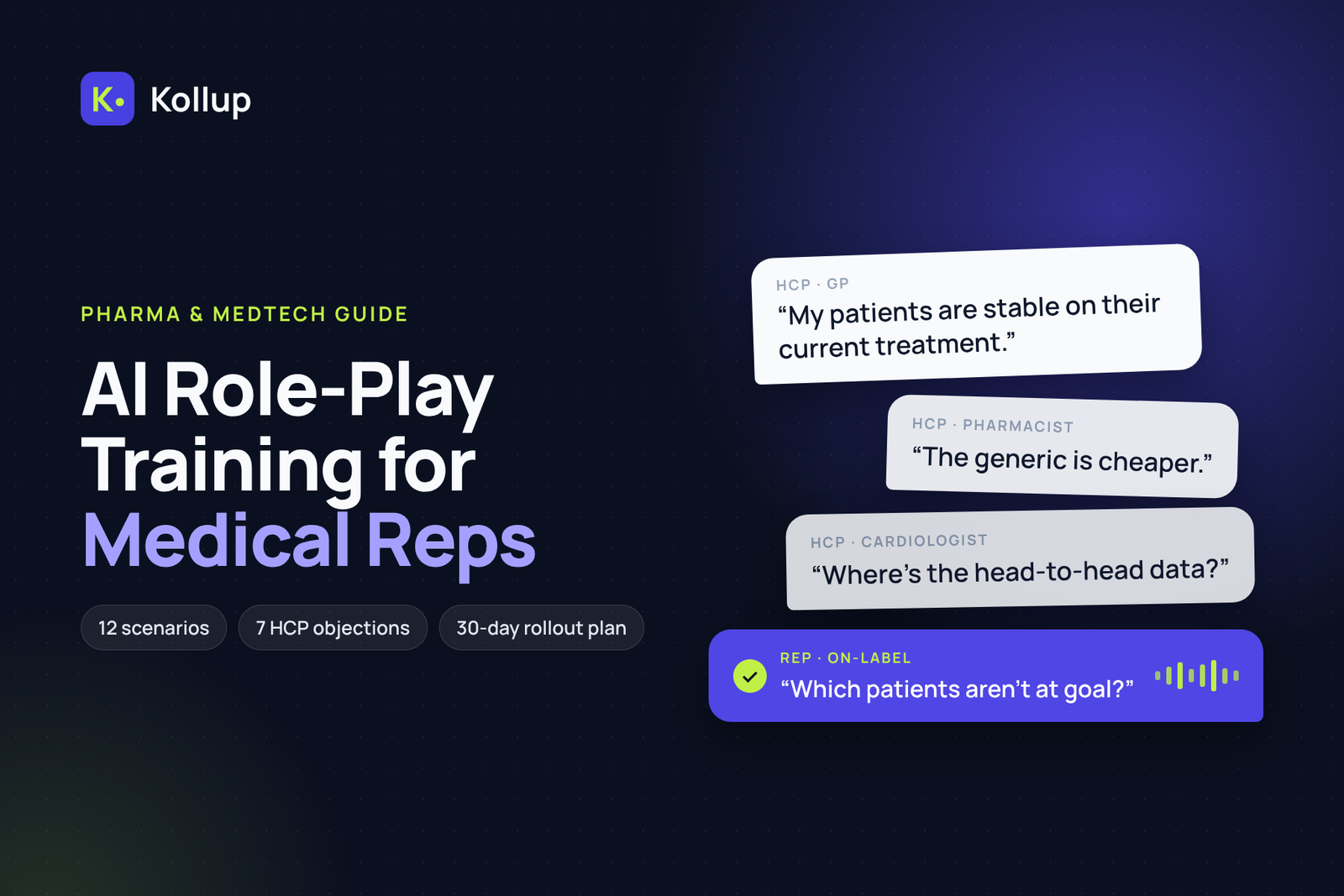
Medical reps get a few minutes with a busy clinician, strict rules about what they may say, and few chances to practise before the call that counts. AI role-play training for medical reps closes that gap: reps rehearse the detail, the objection and the compliant answer by voice with an AI doctor, pharmacist or hospital buyer, and get a scored report straight afterwards.
This guide explains how AI role-play works for pharmaceutical, medical device and diagnostics sales teams, how to keep it compliant, which scenarios to build first, and how to roll it out in 30 days.
Table of Contents
Key takeaways
- Rep time with HCPs is shrinking. Veeva Pulse’s late-2024 report found in-person meetings per HCP down 7% on the previous year, so each remaining call has to count.
- Compliance has to be practised, not only learned. Industry codes in the US and Europe require reps to be trained, to stay on-label and to pass on adverse events. Role-play is where those rules get tested under pressure.
- Build scenarios from approved materials. Personas should use your key messages and product information, so reps rehearse only what they are allowed to say.
- Include “trap” scenarios. An HCP who asks about an unapproved use, or mentions a side effect in passing, shows whether reps hold the line.
- Start with five scenarios. Pick the conversations your reps find hardest, practise them weekly for a month, then expand.
What is AI role-play training for medical reps?
AI role-play training for medical reps is practice in which a pharmaceutical, medical device or diagnostics sales representative holds a realistic, spoken conversation with an AI-simulated healthcare professional, then receives automated feedback on message delivery, objection handling, product knowledge and compliance.
The AI plays a specific customer: a GP loyal to current treatment, a cardiologist who wants head-to-head data, a hospital pharmacist preparing a formulary review, or a surgeon attached to a familiar device. It responds to what the rep actually says, pushes back, and can end the call early, as a real clinician would. Unlike a manager role-play, it is available whenever a rep has ten minutes, and every rep meets the same customer profile and is scored against the same criteria, so results can be compared fairly.
Why medical sales teams need role-play practice now
Medical reps have fewer conversations with healthcare professionals (HCPs), less time in each one and less room for error. Five pressures make deliberate practice more valuable than it was a decade ago:
- Fewer face-to-face meetings. Veeva Pulse’s late-2024 field report found in-person meetings per HCP down 7% on the previous year. A rep who wastes one call may not get another for weeks.
- The rep call still moves prescribing. The same report found a rep call was 30% more likely to lead to a prescription when a digital touchpoint followed within 10 days. The conversation still matters; it just has to land quickly and set up the next step.
- More calls happen by phone and video. Getting past the practice manager, holding a clinician’s attention without a detail aid, and earning a second call are skills most reps never rehearse.
- Every word is regulated. The US FDA’s Bad Ad program lists sales representative presentations as promotion it oversees, and asks HCPs to report claims that downplay risks or overstate benefits. A nervous rep who improvises is a compliance risk.
- Messages change constantly. New indications, new data and new competitors mean the field force has to learn and rehearse a new message quickly, often across several countries and languages.
Traditional training covers the science and the rules in classrooms and e-learning modules. The gap is the spoken conversation itself, which most reps practise only a few times a year on ride-alongs, and otherwise learn in front of customers.
How an AI role-play session works
A good AI role-play session takes 5 to 15 minutes and follows the same loop every time:
- A trainer builds the HCP persona. Specialty, years in practice, current prescribing habits, the objections they raise, how much time they have, language and voice. The persona is grounded in your approved key messages and product information.
- The trainer sets what “good” looks like. For example: open with a relevant question, deliver one approved key message, handle the objection, stay on-label, agree a next step. Compliance criteria can be weighted as heavily as selling skills.
- The rep runs the call by voice. The rep speaks naturally, the AI answers in character, interrupts when time is short, and ends the conversation if the rep reads a script at it.
- The rep gets feedback in seconds. Scores for areas such as discovery, objection handling, product knowledge and closing, with quotes from what the rep actually said and the one thing to change next time.
- The rep repeats and the manager coaches. Reps retry until they hit the standard. Managers review scores across the team and spend coaching time where the reports show a gap.
Compliance: practise the rules, not just the pitch
In medical sales, a fluent rep who strays off-label is a bigger problem than a hesitant one. The industry codes are explicit that reps must be trained:
- United States, pharma: the PhRMA Code on Interactions with Health Care Professionals (in effect since January 1, 2022) asks companies to train every representative who visits HCPs on the applicable laws, regulations and codes. It also requires information to be accurate, not misleading, and to reflect the balance between risks and benefits.
- Europe, pharma: the EFPIA Code of Practice (Article 20.02) requires medical sales representatives to be adequately trained, with enough scientific knowledge to give precise and complete information. They must pass any information on the use of their products, particularly side effects, to their company’s scientific service without delay. EU pharmaceutical law (Directive 2001/83/EC) sets similar duties.
- Medical devices: the AdvaMed Code of Ethics, updated effective November 1, 2025, covers training, education and communication with HCPs for US medtech companies.
Annual e-learning teaches these rules. Role-play tests whether reps apply them when a clinician pushes. Build these four compliance moments into your scenarios:
| Compliance skill | What the AI HCP does | What a good rep does |
|---|---|---|
| Staying on-label | Asks about an unapproved use or patient group | Says it can’t discuss that use and offers a Medical Information request |
| Fair balance | Asks only about efficacy | Answers, then includes the relevant safety information |
| Adverse event recognition | Mentions a patient’s side effect in passing | Stops, acknowledges it, takes the details and follows the company’s reporting process |
| Hospitality and inducements | Asks for a meal, gift or favour the code doesn’t allow | Declines politely and explains what is possible |
Keep the training itself compliant too. Build scenarios only from approved materials, have your medical, legal and regulatory reviewers sign them off like any other training content, and never put real patient data into a practice call.
12 pharma sales role-play scenarios, plus medical devices and diagnostics
Start with the conversations your reps find hardest and your customers find most annoying. These 12 cover pharma, medical devices, diagnostics and key account management.
| # | Scenario | The AI customer | What they say | What good looks like |
|---|---|---|---|---|
| 1 | The three-minute detail | GP between patients | “I’ve got three minutes. What’s new?” | One relevant question, one approved key message, a clear next step |
| 2 | Loyal to current treatment | GP or specialist | “My patients are stable on what they take now.” | Agrees, then asks which patients aren’t reaching their goals |
| 3 | Evidence challenge | Specialist or key opinion leader | “Where’s the head-to-head data?” | States exactly what the evidence does and doesn’t show; offers the paper |
| 4 | Formulary review | Hospital pharmacist | “What’s the budget impact, and is it reimbursed?” | Uses approved health-economic data; doesn’t guess about reimbursement |
| 5 | Unapproved use | Specialist | “Could I use it in children?” | Stays on-label and offers a Medical Information request |
| 6 | Side effect in passing | GP | “One of my patients got a rash, but anyway…” | Stops, takes the details and follows the reporting process |
| 7 | Gatekeeper | Practice manager | “The doctor doesn’t see reps.” | Asks how the doctor prefers to get information; earns a short call |
| 8 | Remote call | Busy clinician on video | “Just email me the information.” | Gives one reason to stay five minutes, then books the follow-up |
| 9 | Device switch | Surgeon | “I’ve used the current system for ten years.” | Asks what slows their current procedure; offers support for a first case |
| 10 | Clinical team adoption | Theatre or cath lab nurse | “We’d all have to learn a new system.” | Lays out the training and in-service plan, not “it’s easy” |
| 11 | Value analysis or tender | Procurement lead | “What’s the cost per procedure? It’ll go to tender.” | Talks total cost and outcomes; maps who else decides |
| 12 | Lab switch | Clinic manager | “We’ve used our lab for years. What’s your turnaround?” | Gives specific turnaround and logistics facts; proposes a trial period |
Give each scenario a difficulty level. Start reps on a cooperative version of the HCP, then raise the pressure: less time, more interruptions, a sceptical tone.
HCP objection handling: 7 common objections and compliant answers
HCP objections are usually clinical concerns, not haggling. A simple four-step structure keeps reps calm and on-label:
- Acknowledge the concern without arguing.
- Clarify with one question to find the real issue.
- Respond with approved evidence only.
- Check what is still unresolved and agree a next step.
The responses below are starting points. Replace the bracketed parts with your approved claims, and have your reviewers sign off the final wording.
“My patients are stable on their current treatment.”
“That makes sense. If they’re doing well, there’s no reason to change. Are there patients who aren’t reaching [treatment goal] on what they take now? For those patients, [approved key message].”
“The generic is cheaper.”
“It is, and for many patients it’s the right choice. Where we’ve seen [product] considered is for patients who [approved patient profile]. Would it help if I left the [approved cost or outcomes data] for those cases?”
“Where’s the head-to-head data?”
“Fair question. There’s no head-to-head trial against [comparator]. What we do have is [approved study and endpoint]. I can leave you the publication so you can judge it yourself.” If a direct comparison does exist, the rep quotes it exactly as approved. If it doesn’t, the rep says so: implying one is a fast route to a complaint.
“Is it reimbursed?”
“It’s reimbursed for [approved indication and conditions in this market]. For anything beyond that, I’ll check and come back to you rather than guess.”
“Could I use it for [unapproved use]?”
“I can only discuss the approved indication. If you’d like information on that question, I can submit a request to our Medical Information team and they’ll respond to you directly.” This one is non-negotiable, and it is the scenario most worth practising under pressure.
“We’re locked into a contract.” (medical devices)
“Understood. When does it come up for renewal, and who will be involved in the review? It may be worth planning an evaluation ahead of that date so you have data from your own cases.”
“We already use another lab.” (diagnostics)
“Makes sense, switching labs is disruptive. What would you change about your current service if you could: turnaround, sample collection, reporting? [Specific approved service facts.] Would a trial on one test panel be useful?”
AI role-play vs traditional role-play
AI role-play doesn’t replace ride-alongs or manager coaching. It gives reps the repetitions those can’t, so coaching time goes on the skills that need a human.
| Manager or peer role-play | AI role-play | |
|---|---|---|
| Availability | When a manager or colleague is free | Any time: the evening before a visit, or in the car park |
| Realism | Colleagues go easy on each other | The HCP pushes back, runs short on time and can end the call |
| Consistency | Varies by who plays the doctor | Every rep meets the same customer profile and criteria |
| Feedback | Depends on the observer, often days later | Scored within seconds, quoting the rep’s own words |
| Compliance checks | Easy to overlook in the moment | On-label, fair balance and adverse event handling can be scored on every call |
| Languages | Limited to the manager’s languages | Multilingual tools let each rep practise in their own language |
| Best for | Relationship nuance, account strategy, live coaching | Repetition, new messages, launches, onboarding, certification |
How to choose an AI role-play tool for medical sales
Many AI role-play tools were built for software sales and cold calling. Medical sales has different customers and stricter rules, so check these nine points before you buy:
- Real voice conversation. Reps speak and the AI answers out loud, with interruptions and time pressure. Typing replies doesn’t train what happens in a consulting room.
- Custom HCP personas. You can set specialty, prescribing habits, objections, time available and personality, not only choose from a generic library.
- Built from your approved materials. Key messages, product information and competitor positioning feed the scenario, so the AI customer reacts to what reps are actually allowed to say.
- Compliance scenarios and scoring. You can build an HCP who asks about an unapproved use or mentions a side effect, and weight staying on-label in the score.
- Reviewable scenarios. Your medical, legal and regulatory reviewers can see and sign off each scenario.
- Clear data handling. Know what is recorded, what is stored, where and for how long. Ask for a data processing agreement, and confirm no patient data is needed.
- Languages. Regional and distributor teams can practise in their own language, and managers can read reports in theirs.
- Fast setup. A trainer should be able to build and assign a scenario in minutes, without an IT project or CRM integration.
- Pricing that fits your team. Enterprise platforms often require annual contracts sized for large field forces. Smaller teams and launch teams need per-seat or usage-based plans.
Kollup’s AI role-play for medical sales teams was built around these points. Trainers build an AI doctor, pharmacist or hospital buyer from their approved materials in minutes. Reps practise by voice in the browser, and every call ends in a scored report that shows whether they stayed on-label and noticed an adverse event. It runs in 28+ languages, keeps no audio recordings, and is priced by seats and a shared pool of practice minutes.
A 30-day rollout plan for medical sales teams
- Week 1: Choose and build five scenarios. Ask reps and managers which conversations go wrong most often. Include at least one compliance scenario: an unapproved-use question or an adverse event mentioned in passing. Build the personas from approved materials, get reviewer sign-off, and set a passing score.
- Week 2: Pilot with one team. A launch team or new-starter cohort works well. Ask each rep for three short sessions a week, and have managers read every report.
- Week 3: Raise the difficulty. Shorten the HCP’s time, add interruptions, and add a remote-call scenario and a stakeholder such as a hospital pharmacist or procurement lead.
- Week 4: Certify and expand. Require a passing score on the core scenarios before a launch or a new territory. Then add the next five scenarios and the next team.
What to measure
- Practice volume: sessions per rep per week. Without repetition, nothing else moves.
- Score progression: whether each rep’s scores rise across attempts on the same scenario.
- Compliance flags: off-label slips and missed adverse events in practice, which should fall towards zero before reps are in the field.
- Time to certification: how long new reps take to pass the core scenarios, compared with your previous onboarding.
- Field signals: call quality ratings from ride-alongs, follow-up meetings agreed and manager feedback, compared before and after the rollout.
Frequently asked questions
What is AI role-play training for medical reps?
AI role-play training lets pharmaceutical, medical device and diagnostics reps practise sales conversations by voice with an AI-simulated healthcare professional, such as a GP, specialist, hospital pharmacist or procurement lead. The AI responds to what the rep says and raises realistic objections. After each call, the rep gets a scored report on message delivery, objection handling, product knowledge and compliance.
Is AI role-play compliant for pharmaceutical sales training?
It can be, if it is set up like any other training material. Build scenarios only from approved key messages and product information, have medical, legal and regulatory reviewers sign them off, and never use real patient data. Used this way, AI role-play supports the training duties in codes such as the PhRMA Code and the EFPIA Code, because reps can practise staying on-label and reporting adverse events.
Does voice role-play help reps who meet doctors in person?
Yes. The hard part of a face-to-face detail is the spoken exchange: opening well, handling an objection without improvising a claim, and agreeing a next step within a few minutes. Voice practice trains exactly that. It also prepares reps for the HCP conversations that happen by phone and video.
Which scenarios should pharma reps practise first?
Start with five: the very short detail with a busy GP, a doctor who is happy with current treatment, a request for head-to-head data, an HCP asking about an unapproved use, and a doctor who mentions a side effect in passing. Together they cover messaging, objection handling and the two compliance moments that matter most.
Can medical device and diagnostics sales teams use AI role-play?
Yes. Device reps can practise with a surgeon attached to a current system, nurses who would have to learn a new one, and a procurement lead running a tender or value analysis review. Diagnostics reps can practise switching a clinic from its current lab, with questions on turnaround times, sample logistics and accreditation.
How often should medical reps practise?
Short, frequent sessions work better than occasional long workshops. Two or three 10-minute calls a week is a realistic target, with extra practice before a launch, a new indication or an important account meeting.
Can I use AI role-play to prepare for a pharmaceutical sales interview?
Yes. Many pharmaceutical and medical device interviews include a role-play in which the candidate sells to an interviewer playing a doctor. Practising with an AI HCP helps you structure a short detail, ask good questions and handle objections calmly. Use a fictional or publicly approved product and stay within its approved indication.
Give every rep a practice HCP
The best medical reps aren’t the ones who know the most data. They are the ones who can deliver an approved message in three minutes, handle a sceptical clinician calmly and stay on-label under pressure. That takes repetition, and AI role-play makes repetition possible for every rep, in every language, before every important call.
Kollup gives pharma, medical device and diagnostics teams an AI doctor, pharmacist or hospital buyer to practise with, built from your approved materials. Tell us the conversation your reps find hardest, and we’ll build that healthcare professional live on a demo call. See how Kollup works for medical sales teams.
Sources
- Veeva, Veeva Pulse Field Trends Report, top insights 3Q24 (November 2024)
- US Food and Drug Administration, The Bad Ad Program
- PhRMA, Code on Interactions with Health Care Professionals (effective January 1, 2022)
- EFPIA, Code of Practice, consolidated version 2026
- AdvaMed, Code of Ethics on Interactions with U.S. Health Care Professionals