
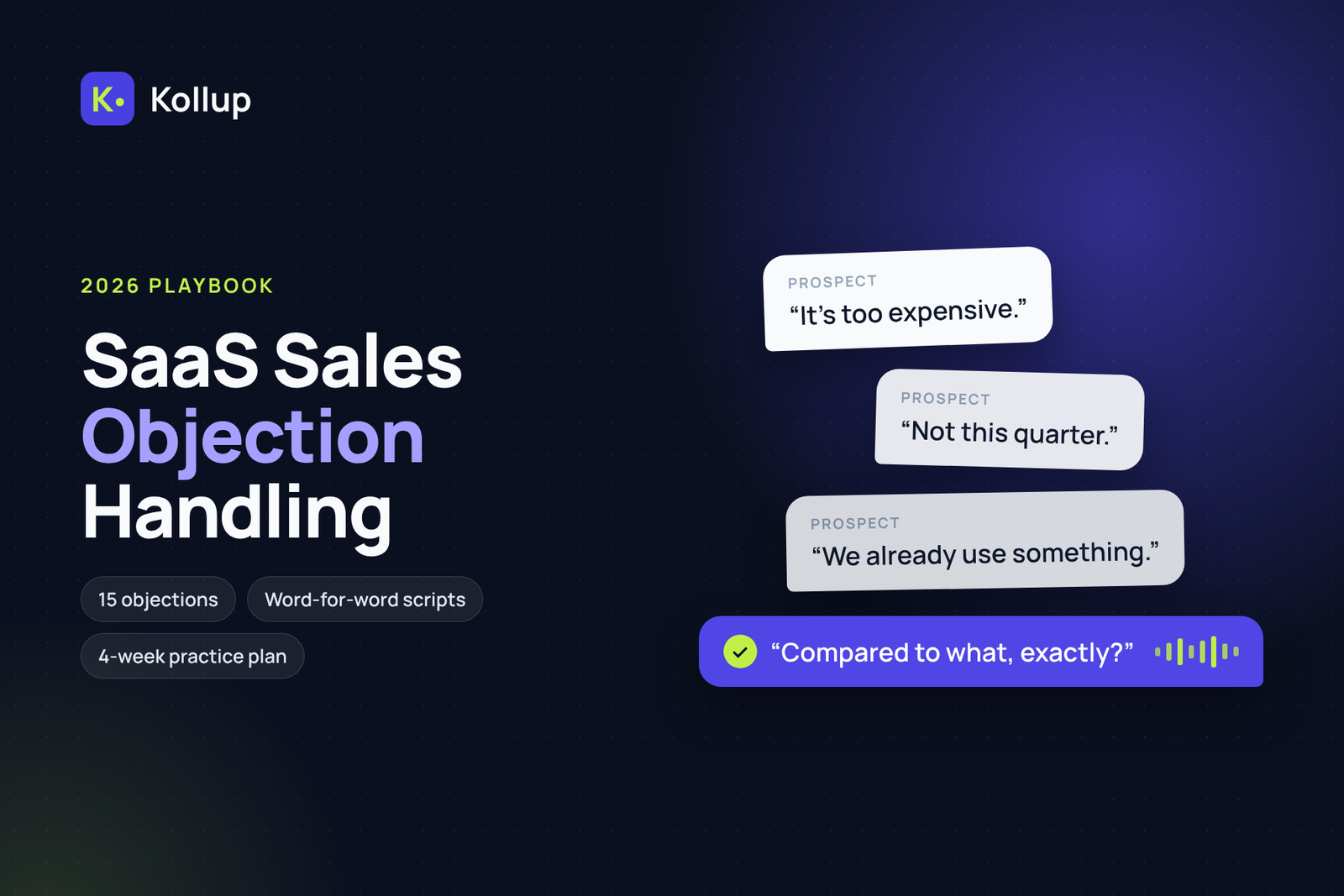
SaaS buyers rarely say yes on the first call. They say “it’s too expensive,” “not this quarter,” or “we already use something.” How your reps respond in those moments decides whether the deal moves forward or quietly dies in the pipeline.
This guide gives you a six-step objection handling process based on Gong Labs’ analysis of 67,149 recorded sales meetings, word-for-word responses to the 15 objections SaaS sellers hear most, and a four-week plan to make those responses automatic.
Table of Contents
Key takeaways
- Diagnose before you respond. In Gong’s data, top performers followed 54.3% of objections with a question; average reps did so only 31.0% of the time.
- Slow down. Top reps pause about five times longer after an objection than average reps, who tend to speed up.
- Isolate the real objection. The first thing a buyer says is often the surface version of a deeper concern.
- Discount last, not first. Reframe price around the cost of the problem, and trade any concession for a commitment.
- Most SaaS objections fall into five groups: price, need or competition, timing, authority, and risk.
- Rehearse out loud. A response your reps have only read will not hold up when a CFO pushes back on a live call.
What is SaaS sales objection handling?
SaaS sales objection handling is the process of uncovering, understanding and resolving a prospect’s concerns about buying subscription software, so the deal can move to its next stage. Those concerns usually involve price, timing, fit, switching cost, security or who has authority to sign.
An objection is not a rejection. It is information about what the buyer currently believes. Good objection handling diagnoses before it responds: it finds the real blocker behind the stated one, then answers it with proof.
Why SaaS objections are different
SaaS objections are harder than one-off product objections because the buyer is committing to an ongoing cost, a migration and a group decision at the same time. Six forces shape them:
- Recurring cost, recurring scrutiny. Buyers model the annual commitment, per-seat growth and renewal price rises, not just this month’s invoice.
- Switching costs. Data migration, integrations and retraining make “we’re happy with our current tool” a rational position, not a brush-off.
- Buying committees. A 2025 Gartner survey of 632 B2B buyers found buying groups of five to 16 people across as many as four functions, and unhealthy conflict in 74% of buyer teams. Each brings their own objection: finance on cost, IT on security, end users on adoption.
- Self-educated buyers. Gartner reports that 75% of B2B buyers prefer a rep-free buying experience. By the time they talk to you, their doubts are already formed.
- Tool fatigue. Many teams are consolidating software. You compete not only with rivals but with “we already pay for too many tools” and with doing nothing.
- Security and procurement reviews. SOC 2 reports, data processing agreements and SSO requirements can stall a deal even when your champion is ready to sign.
The 6-step SaaS objection handling process
The best SaaS reps don’t win objections with clever comebacks. They slow down, ask, and confirm. The six steps below are built on the behaviours Gong Labs found in top performers, and they map closely to the classic LAER model (Listen, Acknowledge, Explore, Respond).
Step 1: Pause and slow down
Top performers pause about five times longer after an objection than average reps. Average reps do the opposite: Gong measured them speeding up from a typical 173 words per minute to 188 when an objection lands. A two-second pause signals confidence and gives the buyer room to keep talking.
Step 2: Probe with a clarifying question
Top performers answered 54.3% of objections with a question, compared with 31.0% for average reps. Ask something like: “Can you help me understand what’s behind that concern?” Avoid starting with “why,” which sounds like a challenge. Mirroring also works: repeat the buyer’s last few words as a question and let them elaborate.
Step 3: Validate the concern
Acknowledge the concern without agreeing that it’s a deal-breaker: “That’s a fair concern. It sounds like you’re weighing the cost against how fast the team would actually adopt it.” Buyers who feel understood stop defending their position and start explaining it.
Step 4: Isolate the real objection
Ask: “Setting that aside for a moment, is there anything else that would stop you from moving forward?” If a new concern appears, that is often the real one. If nothing else comes up, you know the first objection is the one to solve.
Step 5: Respond with a reframe and proof
Ask permission first (“Can I share how a similar team handled this?”), then reframe. Price becomes the cost of the problem. Bad timing becomes the cost of waiting. Back the reframe with something concrete: a number from discovery, a customer story, a security document or a pilot offer.
Step 6: Confirm it’s resolved, without leading
“Does that make sense?” invites a polite false yes, and buried objections come back in procurement. Gong suggests asking instead: “What part of your concern do you feel is still left unaddressed?” If the answer reveals a new concern, loop back to Step 2.
Quick memory aid: Pause, Probe, Validate, Isolate, Reframe, Confirm.
Objection, stall or brush-off? How to tell them apart
Not every “no” needs the same response. Specific objections are good news: the buyer is evaluating you seriously. Vague ones need a question before they need an answer.
| Type | What it sounds like | What it usually means | Best move |
|---|---|---|---|
| Real objection | “Per-seat pricing doubles our cost once we hit 40 users.” | A specific concern tied to a buying criterion | Run the six steps and answer with proof |
| Stall | “Let’s revisit next quarter.” | Not convinced yet, no urgency, or someone else must agree | Find the blocker, then agree a dated next step |
| Brush-off | “Just send me an email.” | A reflex to end the call before interest exists | Acknowledge it, then earn 30 more seconds with one relevant insight |
The fastest test is the isolating question from Step 4. A real objection survives it; a stall usually reveals the true concern behind it.
The 15 most common SaaS sales objections (and what to say)
Use these as starting points, not scripts to recite. Replace the bracketed parts with your own numbers, customers and proof.
| # | Objection | Category | Core move |
|---|---|---|---|
| 1 | “It’s too expensive.” | Price | Compare against the cost of the problem |
| 2 | “We don’t have budget this year.” | Price | Tie it to a funded priority |
| 3 | “Per-seat pricing won’t scale for us.” | Price | Model growth together, in writing |
| 4 | “We can’t commit to an annual contract.” | Price | Reduce adoption risk with a pilot |
| 5 | “Can you do better on price?” | Price | Trade concessions for commitments |
| 6 | “We’re happy with our current tool.” | Need | Find the gap they already feel |
| 7 | “We’ll build it in-house.” | Need | Compare build-and-maintain cost |
| 8 | “We already pay for too many tools.” | Need | Show what you replace |
| 9 | “Not right now. Maybe next quarter.” | Timing | Quantify the cost of waiting |
| 10 | “We’re locked into a contract.” | Timing | Plan around the notice date |
| 11 | “I need to check with my boss.” | Authority | Map and equip the committee |
| 12 | “Just send me an email.” | Authority | Earn the next 30 seconds |
| 13 | “It has to go through security review.” | Authority | Start the review in parallel |
| 14 | “Our team won’t use it.” | Risk | Offer a rollout plan, not reassurance |
| 15 | “What if your company isn’t around in two years?” | Risk | Show what protects them |
1. “It’s too expensive.”
What it usually means: The buyer doesn’t yet see value that clearly exceeds the cost, or is comparing you with the wrong alternative: a cheaper tool, a spreadsheet, or doing nothing.
What to say: “That’s fair, it’s a real investment. Can I ask what you’re comparing it to? Earlier you mentioned [problem] costs your team about [X hours or $Y] a month. If we cut that in half, the subscription pays for itself in [Z] months. Does that math hold up on your side, or am I missing a cost?”
Avoid: Defending the price feature by feature, or discounting before you know what they’re comparing you to.
2. “We don’t have budget this year.”
What it usually means: Either a genuine freeze, or your problem isn’t attached to a funded initiative yet.
What to say: “Understood. Budgets usually follow priorities. Is [problem] on the list of things leadership wants fixed this year? If it is, who owns that budget? I can put together a one-page business case you could take to them.”
Avoid: Assuming “no budget” means “no money.” Champions find budget for problems their leaders care about.
3. “Per-seat pricing won’t scale for us.”
What it usually means: Finance is modeling years two and three and worries cost will grow faster than value.
What to say: “Good catch. Let’s model it now so nobody is surprised at renewal. How many seats do you expect in 12 and 24 months? We can look at [volume tiers, a price lock or usage-based options] so your cost per user falls as you grow.”
Avoid: Vague promises like “we’ll look after you at renewal.” Put the numbers in writing.
4. “We can’t commit to an annual contract.”
What it usually means: Adoption risk. They fear paying a year upfront for software the team won’t use.
What to say: “That makes sense if you’re not sure about adoption. What would you need to see in the first 60 to 90 days to feel confident? We could start with [a paid pilot, one team or quarterly billing], agree success criteria now, and expand once you’ve hit them.”
Avoid: Pushing the annual discount harder. It answers a price question they didn’t ask.
5. “Can you do better on price?”
What it usually means: Late-stage negotiation, often procurement doing its job. It is rarely a deal-breaker on its own.
What to say: “I can look into it. Help me understand: is price the only thing between us and a signature this month? If I can get you [concession], can you commit to [longer term, earlier start date, a case study or signing by a date]?”
Avoid: Giving a discount without getting something back. Trade, don’t concede.
6. “We’re happy with our current tool.” / “We already use [competitor].”
What it usually means: Switching feels risky and expensive, and you haven’t found a gap that justifies it yet.
What to say: “Glad it’s working. I wouldn’t suggest replacing something that works. Out of curiosity, if you could change one thing about how [tool] handles [job], what would it be? That’s exactly where teams who switched to us noticed the difference: [specific outcome].”
Avoid: Criticizing the competitor. It forces the buyer to defend their own past decision.
7. “We’ll build it in-house.”
What it usually means: An engineering-led buyer who wants control and is likely underestimating long-term maintenance.
What to say: “Your team could definitely build it. The question is whether it’s the best use of their time. What else is on the engineering roadmap this year? Building is usually the cheap part; maintaining, securing and updating it for years is where the cost lands. Want to compare a three-year build-and-maintain estimate with our subscription?”
Avoid: Implying their engineers aren’t capable.
8. “We already pay for too many tools.”
What it usually means: Consolidation pressure from finance. Any new line item needs to remove another one.
What to say: “Completely fair. Most teams are cutting tools right now, not adding them. Which of your current tools overlap with what we do? If we can replace one or two, your net cost could go down. Want to map your stack together?”
Avoid: Claiming you’re “not just another tool.” Show the overlap and the math instead.
9. “Not right now. Maybe next quarter.”
What it usually means: Your problem isn’t a priority initiative, or there’s no felt urgency. SaaStr founder Jason Lemkin calls this the most common SaaS objection, because software purchases tend to follow the handful of initiatives a company commits to each year.
What to say: “Totally understand. What’s taking priority this quarter? Is [problem] connected to any of that? If waiting means [specific cost of delay], it may be worth a small start now. If not, let’s put a specific date in the calendar to revisit.”
Avoid: Fake urgency such as “this price expires Friday.” Use the real cost of delay.
10. “We’re locked into a contract with another vendor.”
What it usually means: A real constraint, not a brush-off. It is a future opportunity with a known date.
What to say: “Makes sense. When does it renew, and what’s the deadline for giving notice? Notice periods often fall well before the renewal date. Could we schedule a check-in ahead of that window, and in the meantime test us with one team?”
Avoid: Walking away. Log the renewal and notice dates in your CRM.
11. “I need to check with my boss / the team.”
What it usually means: Your contact isn’t the only decision maker, which is normal in SaaS. Occasionally it’s a soft no.
What to say: “Of course. Who else will weigh in, and what will matter most to each of them? I can prepare a short summary in their language: ROI for finance, security for IT, workflow for the team. Would it help if I joined that conversation for 15 minutes?”
Avoid: Going around your contact. Equip your champion instead.
12. “Just send me an email.”
What it usually means: On a cold call, a reflex to end the conversation. Later in the cycle, it can be a genuine request.
What to say: “Happy to. So I send something useful rather than a generic deck, what’s your biggest headache with [area] right now? [If they answer, you have a conversation. If not:] I’ll send a short note on [specific insight]. If it’s relevant, can we grab 15 minutes on Thursday?”
Avoid: Sending a 30-slide deck with no next step booked.
13. “This has to go through security / IT / procurement review.”
What it usually means: A standard step in mid-market and enterprise SaaS. Not a brush-off, but a real risk to your close date if it starts late.
What to say: “Absolutely, and it’s better to start now than at the finish line. Who runs the review, and do they use a standard questionnaire? I’ll send our [SOC 2 report, data processing agreement and SSO details] today so it runs in parallel with the business case.”
Avoid: Leaving security to the end. Ask about the review process during discovery.
14. “Our team won’t use it.” / “Implementation looks like too much work.”
What it usually means: Fear of a failed rollout, disruption, and being blamed for it.
What to say: “That’s the right worry. Software nobody uses is the most expensive kind. How did your last rollout go? Here’s how we’d handle onboarding: [timeline, owners, training]. Could we start with one team, agree what ‘adopted’ means, and expand only once we’ve hit it?”
Avoid: Saying “it’s easy.” Show the plan.
15. “You’re a small company. What if you’re not around in two years?”
What it usually means: Vendor risk, and career risk for the champion who recommends you.
What to say: “Fair question. You’re trusting us with [data or a core workflow]. Here’s what protects you: [data export at any time, contract terms, customers like you, how we’re funded]. Smaller vendors also tend to ship requests faster. What would make you comfortable here?”
Avoid: Getting defensive or overpromising.
How to prevent objections at each stage of the SaaS sales cycle
The cheapest objection is the one you prevent in discovery. Most late-stage objections trace back to a question nobody asked earlier: who owns the budget, what the problem costs, who else must approve.
| Stage | Objections that show up | How to prevent them |
|---|---|---|
| Cold call or outbound | “Send me an email,” “not interested,” “we already use X” | Open with one specific, relevant insight. Ask for minutes, not half an hour. |
| Discovery | “Not a priority,” “no budget” | Quantify what the problem costs. Ask who owns the budget and which initiatives are funded this year. |
| Demo | “Too complex,” “missing feature X,” “happy with our current tool” | Show only the two or three workflows tied to their pain. Show the switching path. |
| Proposal | “Too expensive,” “no annual commitment,” “per-seat won’t scale” | Anchor price to the ROI they agreed in discovery. Offer structured options. |
| Procurement and legal | Security review, discount requests, contract terms | Send security documents early. Decide your give-and-get trades before the call. |
You can also pre-empt your two or three most common objections in the pitch itself. Naming a concern before the buyer does (“You might be wondering how this fits with the tools you already use”) takes the sting out of it and shows you understand their situation.
How to build an objection handling playbook your team will actually use
An objection playbook is a living library of the objections your team hears, the responses that work, and the proof behind them. Generic lists, including this one, are a starting point. Your own library is what wins deals.
- Capture the exact words. Log objections verbatim from call recordings or notes. “Too pricey for a team our size” and “too expensive” need different answers.
- Tag every objection. Record the category (price, need, timing, authority, risk), the deal stage, the buyer’s role and the deal outcome.
- Write two or three responses per objection. Attach proof to each one: a customer story, a metric, a security document, a pricing scenario.
- Track what moves deals forward. Keep the responses that lead to a next step. Retire the ones that don’t.
- Review it monthly as a team. Share the toughest objection of the month and the best answer anyone found.
If the same objection keeps coming from well-qualified buyers, it is no longer just a sales problem. Treat it as a signal for product, pricing or positioning, and share it with those teams.
How to practice objection handling (a 4-week plan)
Knowing the right response is not the same as delivering it calmly when a buyer pushes back. The gap between top and average reps in Gong’s data is behavioural: pace, pauses and questions. Behaviours change through repetition out loud, not through reading a playbook.
Four ways to practice, compared
| Practice format | Strength | Limitation |
|---|---|---|
| Peer role-play | Free and easy to start | Colleagues go easy on each other, and it competes with selling time |
| Manager role-play | Expert feedback | Managers rarely have time to run it weekly for every rep |
| Call review | Uses real objections from real buyers | Happens after the deal moment has passed |
| AI voice role-play | Unlimited, on-demand reps against a realistic buyer | Needs your own objections loaded in to feel real |
The 4-week practice plan
- Week 1: Pick your top five. Choose the five objections your team hears most often from your playbook. Write a response for each and rehearse every one out loud at least three times.
- Week 2: Drill the first three steps. Run short 10-minute sessions three times a week, with objections thrown at random. Score only the pause, the clarifying question and the validation, not the answer.
- Week 3: Stack objections and personas. Practice calls where price, timing and authority objections arrive in the same conversation, from different buyers: a CFO, an IT lead, an end user.
- Week 4: Compare practice with reality. Review recordings of real calls against your practice runs. Update the playbook, then start again with the next five objections.
This is where AI voice role-play for SaaS sales training fits. Kollup lets small sales teams rehearse objection handling out loud with AI buyers who push back the way real prospects do, so reps build the habit of pausing, asking and reframing before they meet a real buyer. Reps can practice whenever they have ten minutes, without waiting for a manager’s calendar.
8 objection handling mistakes that cost SaaS deals
- Answering the first objection you hear. Without isolating it, you may give a strong answer to the wrong concern, which makes the real one worse.
- Monologuing. Gong found average reps often respond with a long, knee-jerk pitch. Keep answers short and end with a question.
- Discounting first. An early discount tells the buyer your price was never real and sets the anchor for every renewal.
- Arguing. “Yes, but…” forces the buyer to defend their position. Validate first, then reframe.
- Leading confirmation. “Does that make sense?” gets a polite yes. Ask what part of the concern is still open.
- Single-threading. One contact can’t answer for finance, IT and legal. Find out early who else is involved.
- Fake urgency. Invented deadlines erode trust. Use the real cost of delay instead.
- Treating every objection as a stall. Some objections reveal a genuinely poor fit. Disqualifying a bad deal early keeps your forecast honest.
Frequently asked questions
What are the most common objections in SaaS sales?
The most common SaaS sales objections fall into five groups: price (“it’s too expensive,” “no budget”), need (“we’re happy with our current tool”), timing (“not right now”), authority (“I need to check with my boss”) and risk (security reviews, adoption, vendor stability). SaaStr’s Jason Lemkin singles out “not right now” as the most common of all.
What is the best objection handling framework for SaaS sales?
LAER (Listen, Acknowledge, Explore, Respond) is the most widely taught objection handling framework. Gong’s research adds steps that top performers use: pausing before responding, isolating the real objection, asking permission before reframing, and confirming the concern is resolved. The six-step process in this guide combines both.
How do you handle “it’s too expensive” without discounting?
Ask what the buyer is comparing your price to, then quantify the cost of the problem they described in discovery and show the payback period. Offer structural options, such as a pilot or a smaller starting scope, before touching price. If you do discount, trade it for a commitment like a longer term or an earlier start.
What is the difference between an objection and a stall?
An objection is a specific concern tied to a buying criterion, such as cost at a given seat count. A stall is vague and delays the decision, such as “let’s revisit next quarter.” Test with an isolating question. A real objection holds up; a stall usually reveals the true concern behind it.
How do you handle “we already use a competitor”?
Don’t criticize the competitor. Acknowledge that their current tool works, then ask what they would change about it if they could. Their answer shows you the gap. Position your product against that specific gap, and offer a side-by-side test or a pilot with one team to lower the risk of switching.
How do SDRs and AEs handle objections differently?
SDRs mostly face reflexive brush-offs on cold calls, such as “send me an email” or “not interested.” Their goal is to earn the next 30 seconds and a meeting. Account executives face substantive objections about value, risk and contract terms. Their goal is to resolve those with proof and to involve every stakeholder in the buying group.
How can a sales team practice objection handling?
Build a playbook of your team’s real objections, then rehearse responses out loud every week. Combine peer role-play, call reviews and AI voice role-play tools such as Kollup, which let reps practice against realistic AI buyers on demand. Focus early practice on pausing and asking questions, not on perfect answers.
Turn objections into practiced responses
Objection handling is a skill, not a script. The six steps give your reps a structure, the 15 responses give them words, and deliberate practice makes both automatic under pressure.
Kollup helps small B2B sales teams get those repetitions in. Your reps practice the objections in this guide by voice with AI buyers, until the pause, the question and the reframe come naturally on real calls. See how Kollup works.
Sources
- Gong Labs, The 7 best objection handling techniques for sales reps, by Chris Orlob (published January 2019, last updated March 2026)
- SaaStr, The most common objection in SaaS sales is “Not Right Now”, by Jason Lemkin
- Gartner, B2B Buying: How Top CSOs and CMOs Optimize the Journey
- Gartner, Sales survey finds 74% of B2B buyer teams demonstrate “unhealthy conflict” during the decision process (press release, May 7, 2025)